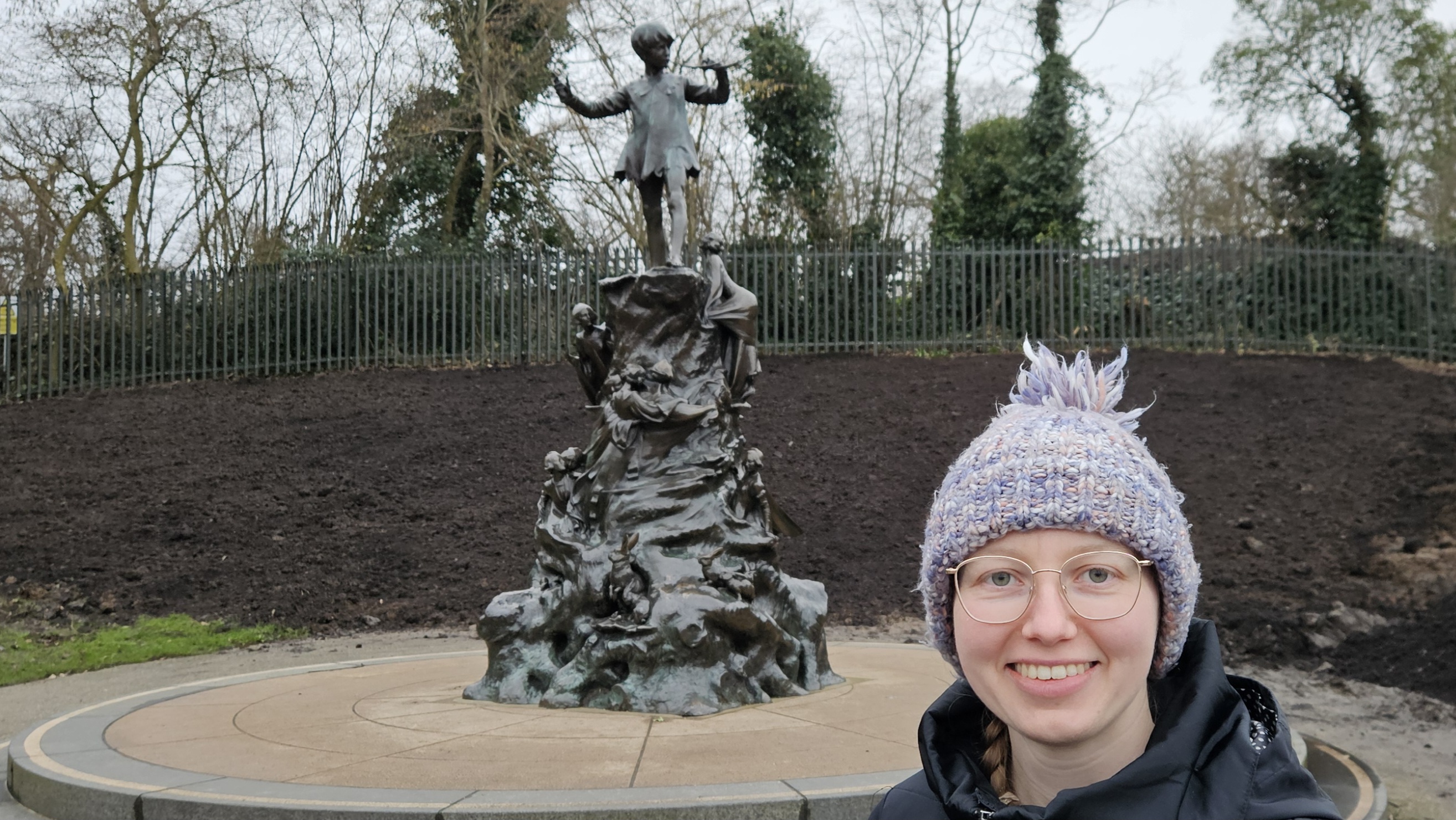
With tomorrow being the 3rd anniversary of the Peter Pan & Wendy live action movie by Disney+, it felt a fitting time to showcase another comfort character of mine – that of Wendy Darling.
There’s a lot that can be analysed of the other characters too of course, and perhaps we’ll start with those, though the primary emphasis will be on Wendy – who, I’d argue, is as much the main character (or perhaps even more so) than the titular character himself.
Starting with Peter Pan. For some, he’s a baby who passed away “still with his baby teeth”, and enters the nursery only to bring Wendy to their forever home of Neverland (heaven). For others, he’s a figure of which Wendy disassociates herself into because of darker and more sinister themes of abuse. The fight with Hook being a parallel representation to that of Wendy and her father. This particular interpretation is one I’m not going to entertain further, although I can perhaps see why some may come to such a conclusion. After all, Peter Pan was to be played by a girl in JM Barrie’s original screenplay, and the same actor was to play both Captain Hook and Wendy’s father, Mr Darling too. Thus providing the somewhat implication that the two worlds were connected in one way or another.
I, however, see this alter-ego ideology as one with much more innocent undertones. It’s more prominent in the 1953 animated version where I see the parallel between the ‘young’ and the ‘authoritative’ being that of Peter and Hook in Neverland, and Wendy and the passing of time in the real world. After all, it’s this notion of growing up which catalyses the adventure in the first place. Evident more so by the idea Hook could be seen as a personified version of an older self with the impending sound of time ticking away. Wendy is simply there to watch the battle unfold. The battle which merely represents the defiance of growing up. What’s interesting, however, is the fact she surprises even herself when she realises she doesn’t want what Peter Pan has. She no longer entertains his cockiness, his ‘everything’s a game’ persona, nor his general childish ways anymore, because she wants a life beyond childhood games. She just needed to see the alternative to realise this. And I think this is where the 2023 live action portrays it perfectly; we see the conflict in her mind through the hesitation at first, then the foretelling of her future in moving pictures. It captures her maturing in a beautiful way.
Being aware of gender here is important too. This ongoing rivalry between Peter Pan and Captain Hook is just a side storyline, for the true journey into Neverland is Wendy’s coming of age arc. It’s the figurative transformation of preparing a young girl into womanhood, and subsequently of course, motherhood. My overall interpretation of Peter Pan is that he is a baby, but one who hasn’t yet been born. A child who simply hasn’t had the chance to live, all because Wendy hasn’t yet met him. Her role of caring for the lost boys, singing lullabies, and comforting her younger brothers are all setting her up for her own motherhood. And an important note in the book is that of Mrs Darling’s kiss – the one “Mr Darling could never get”. I believe this kiss to be of Peter Pan. That of a baby not yet in existence but in the mind of a mother. This is why Peter comes only for girls – firstly Mrs Darling, then Wendy, then Jane… the cycle continues; for there comes a point in each of these girl’s lives where they mature maternally. And when this time comes, so does too their kiss. A kiss that is saved for a child. In Wendy’s case a child she wouldn’t meet until the end. A child brought into the world only because she accepted her responsibility to grow up .
To see the contrast of Wendy’s character maturing from a young girl who wants nothing more than for everything to stay the same, to that of a young woman who brings all the mother-less lost boys home is executed beautifully in this new adaption by Disney. A special mention also for their inclusion of Wendy’s comment of “I’m not even sure I want to be a mother”, because whilst we know Wendy does go on to have her own daughter, Jane, she at least acknowledges it’s an option not a fate which subtly touches on the childfree by choice movement.
My connection towards Wendy comes from the very same notion of not yet feeling ready to grow up. I like to believe the character went on to keep the magic alive as she entered adulthood and beyond. And perhaps that ‘box’ JM Barrie mentions so often in the book is that of your inner childhood joy which is carried within. A box which I now find comfort in as I battle with the everyday responsibilities and commitments of life.
Leave a Reply