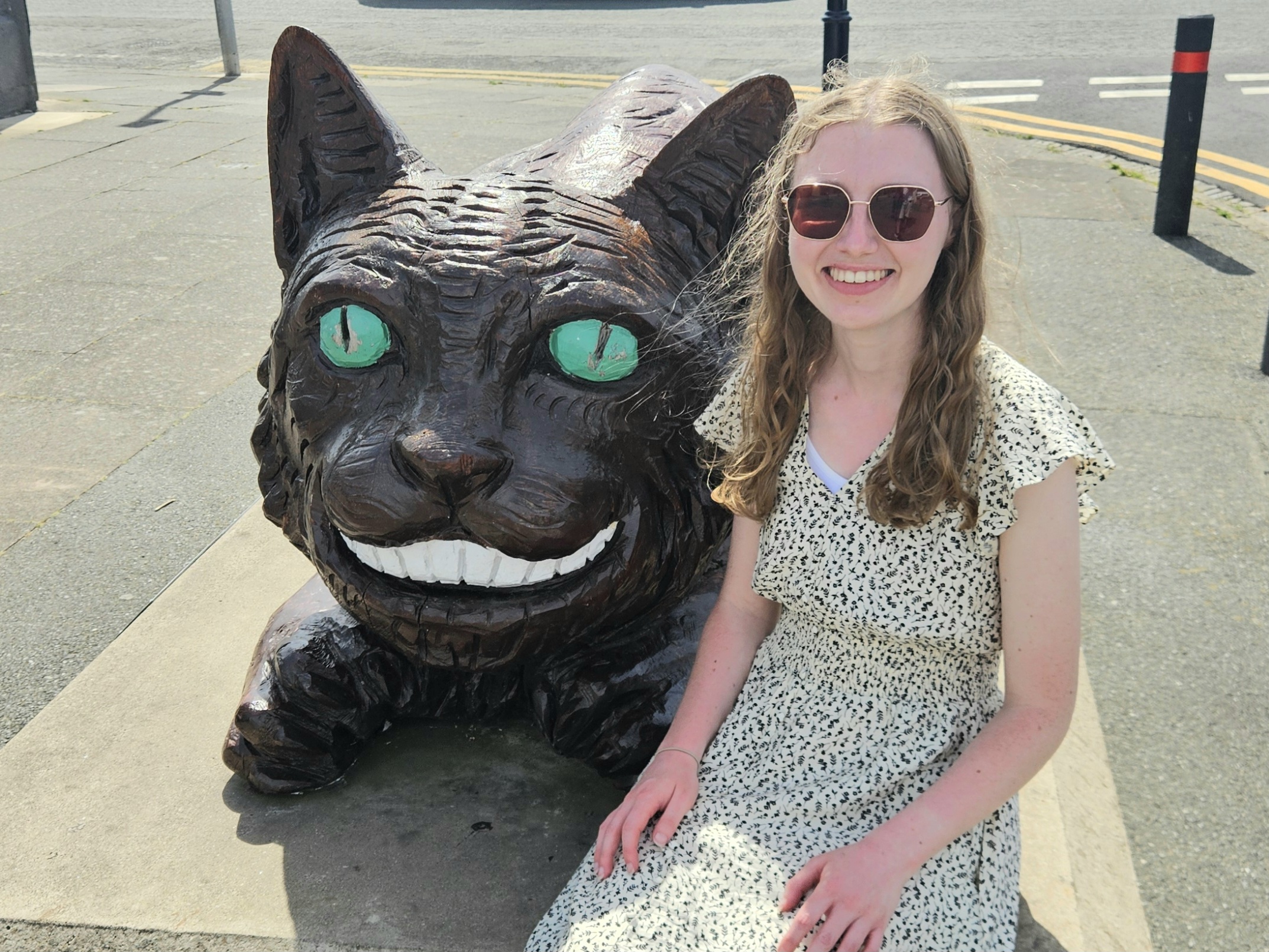
This week we celebrate the 10th anniversary of the second instalment of Tim Burton’s Alice in Wonderland – Through the Looking Glass – and what a better tribute than that of an Alice analysis – (try saying that out loud haha!)
Now most of my comfort characters are ones I can relate to on a personal level, in one way or another, and I will admit the character of Alice is a fairly new addition to that list. I was never a huge fan of the 1951 Disney animation. To me, it felt too.. noisy.. for lack of a better word. Don’t get me wrong I now understand the need for nonsense and chaos to portray the story’s intentions, but growing up, it was never a particular favourite. In 2010 however, Tim Burton brought the story to life in his own way. And it was seeing his approach of an adult Alice in the land of Underland which made me revisit the original source material.
My curiousity led me to read the book as an adult. And as always, it’s worth understanding the context of both the date and the author before reading such classical literature. Lewis Carroll was the pen name of Charles Lutwidge Dodgson; a mathematician who studied, and later taught, at Christ Church College, Oxford. With this in mind, therefore, you can start to see the correlation of mathematical themes against the nonsense in Alice’s adventures. Proportions, time, and even space itself is found to be anything but logical. And so, it often reads as if this novel is based purely on Carroll’s mocking of logic and of what’s proper. As someone who also studied maths at university, I found this juxtaposition a fun one to explore. In a similar way, having also studied English Language & Linguistics at university, I find the way Carroll plays with words an exciting one. There’s a lot of creativity at work with the lexicon and semantics he uses. One of my favourite examples is that of the Mock Turtle story. To paraphrase, Alice asks why the Mock Turtle calls his school master a “Tortoise” when he is, in fact, a turtle; to which he replies “We called him a Tortoise because he taught us”. I find the overall writing of the book intelligently written despite being full of nonsense. And I think its because of this that Alice in Wonderland has been so successful.
Whilst I’m not going to do a whole book analysis here, nor a comparison between it and its various adaptations into screen, play and theatre, I am instead going to focus on the character of Alice in Tim Burton’s adaptation.
Played by Mia Wasikowska, we are first introduced to Alice as a young adult on the verge of recieving a proposal. Yet she knows that’s not something she wants. Her fiesty spirit to be herself, and her defiance to break from the norm in order to follow her curiosity, is where the true story begins. And we enter the world of Wonderland (or ‘Underland’ in this case). For all its whimsy and nonsensical themes, its simple arc is that of a young girl’s navigation through an adult world where she just feels she doesn’t belong. The pretty epic journey of self-discovery to identity the ‘real Alice’ in the first movie, and the ‘learning from the past’ trope in the second is done in such a way we see battles with higher authorities, fighting expectations, and the ultimate revelation of what the adventure was all for. And that is to learn who the real Alice is, and the lessons we can take from the past.
I think one of the reasons I resonated so much with her in both movies, yet more prominantly in the first, is because I’ve often felt out of place; not fully understanding the way the real adult world works. So watching this young girl navigate her way through an unfamiliar world by trying to make sense of situations, scenarios, and people who are different to her, felt somewhat soothing and comforting. Like Alice, I’ve never seemed to stick (or rather been able to stick) to traditional pathways. My mind is often elsewhere, taken up by thoughts of a more fictional or daydream nature. But the very fact we see her succeed in her own endeavours at the end of the second movie, provides the confidence that sometimes deviating from the expected path, and having trust in yourself, is above all needed in finding, and becoming, you.
Leave a Reply